
Blog
EDCF Global Cinema Seminar at IBC 2026
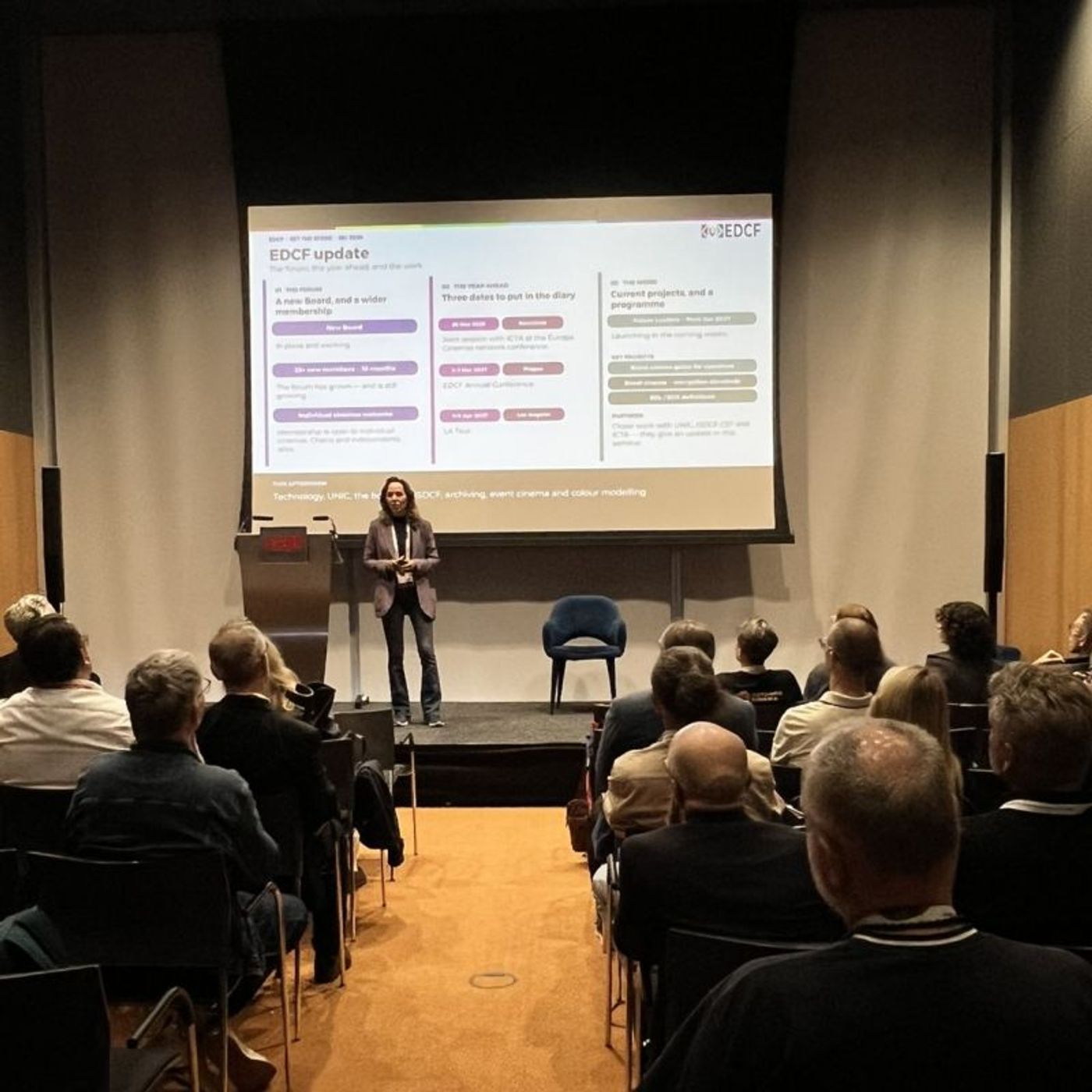
The EDCF once again brought together cinema industry professionals for its annual Global Cinema Seminar at IBC 2026 in Amsterdam, continuing its long relationship with the convention.
The audience reflected the breadth of the industry, with representatives from trade associations, equipment manufacturers, studios, post-production and mastering companies, sound and image specialists, integrators, and cinema operators.
Setting the scene
Cathy Huis in 't Veld-Esser, President of the EDCF, opened the seminar with an update on the Forum's recent activities and upcoming events. She reported that the EDCF had welcomed more than 25 new members over the past 18 months, as it continues in its efforts to represent the whole cinema technology value chain.
In terms of upcoming events, she previewed a joint session with the ICTA at the Europa Cinemas network conference in Barcelona on 26 November, confirmed that the 2027 EDCF conference would take place in Prague on 2-3 March, and announced the next edition of the LA Tour for 8-9 April.
On current EDCF projects, she pointed to the operators' guide on event cinema, industry discussions on encryption standards for alternative content, and ongoing work on end-of-life and end-of-support definitions. She also unveiled the EDCF Future Leaders programme, set to run from January 2027. More details will be revealed about the initiative in the coming weeks.
Analogue's unlikely comeback
Patrick von Sychowski, Vice-President of the EDCF, opened the programme with an industry overview, looking at the key trends currently shaping our sector. Patrick argued that the projection booth has become a marketing asset, as the most talked-about films of 2026 were released in analogue formats. VistaVision returned with The Brutalist and One Battle After Another, while 70mm was driven by The Odyssey, with the 41 IMAX 70mm locations across the world delivering 13 percent of the title's entire gross. He noted the revival runs up against a thinning skills base, since projectionists largely disappeared during the digital transition. At the same time, ScreenX, 4DX and Dolby Cinema all posted record openings on Spider-Man: Brand New Day, evidence that the market can support more than one PLF format. And this trend keeps on giving, with Disney's forthcoming Infinity Vision certification and the growing list of proprietary formats including HDR by Barco, cinema-branded premium rooms such as EPIC by Vue, and the slow democratisation of direct-view LED displays.
Patrick also touched upon the topic of the laser transition, suggesting that the case had shifted from energy and cost efficiency to, potentially, access to studio certification. He closed his presentation on shifting audience behaviour: lengthening holdovers fuelled by word of mouth, a repertory boom driven by younger audiences rather than nostalgia, and growing "format literacy", with audiences choosing the format before the showtime.
Martin Putto, Chief Analogue Technician at KINO Rotterdam and one of Europe's most experienced 70mm projectionists, aptly picked up Patrick's presentation with a hands-on account of running The Odyssey in 70mm throughout the summer. Drawing on years of preparing large-format analogue presentations, including previous screenings of Interstellar, Die Hard and 2001: A Space Odyssey, he walked through what the format demands in practice, from handling and threading a print of considerable size and weight to the physical strain on ageing equipment and the staff preparation required for a run of this scale. His account underscored the success that premium analogue formats are enjoying, and that it depends on a small and ageing pool of projectionists able to operate them.
The European market and policy picture
Sonia Ragone from UNIC, the trade body of European cinema operators, introduced her presentation by setting out the scale of the European market: 870.2 million admissions and €6.9 billion in box office across 39 countries and more than 40,000 screens in 2025, with year-to-date 2026 box office in EMEA up 29 percent on 2025 and 8 percent above the pre-pandemic average.
Sonia gave an update on the UNIC Technology Group, which closely collaborates with the EDCF, and listed among its key priorities energy efficiency, staff training, legacy equipment, cybersecurity, sound levels, AI and automation, content delivery, and accessibility.
In a brief EU policy update, she flagged ongoing discussions around exclusivity, territoriality of copyright, AI, piracy, and the future of the Creative Europe and MEDIA programmes. She closed on UNIC's research and advocacy for public support schemes for the laser transition, citing Italy's national support mechanisms as a working example.
Conversations across the industry
This session was followed by three in-depth conversations that anchored the rest of the afternoon, starting with Tomasz Witkowski (Underground Slate and Soho Media Club) and Richard Welsh (SMPTE and Volustor), who together examined how AI tools are genuinely changing film production processes. Richard noted that AI benchmarks have moved from around 60 to 70 percent accuracy a couple of years ago to roughly 90 percent today, above the 80 to 85 percent typically achieved by human experts, and warned that the sheer number of AI content-creation tools now on the market makes the space difficult to navigate. Tomasz demonstrated this in practice, showcasing a short AI-generated film he created from a single photograph in around four hours using a consumer editing tool. Both agreed AI already touches every stage of the pipeline, from pre-visualisation to VFX to dubbing and subtitling, and flagged copyright and digital twin misuse as a serious concern, alongside newer piracy risks such as AI-generated content streamed without a defined endpoint.
A following session featured Lou Burkart, Archival Curator at Eye Filmmuseum, in conversation with Patrick, exploring the EYE's role as custodian of Dutch cinematic heritage. Discussing the rising success of repertory cinema with younger audiences, Burkart pointed to a growing appetite for pre-digital film as a physical, communal experience, distinct from algorithm-driven viewing habits, and noted that visible traces of age in archival prints are increasingly appreciated as markers of authenticity. On restoration, she described modern digital tools as enabling far more precise correction of historic colour processes than previously possible, while archives deliberately avoid creative alteration, applying a reversibility principle comparable to painting restoration. Rights clearance, she noted, is negotiated with rights holders before restoration work begins rather than after, since rights holders themselves often lose track of where original negatives are held.
We continued on the topic of alternative content with event releases, as Cathy Huis in 't Veld-Esser and Weronika Kolodziej (Deluxe) discussed the EDCF's work on interoperability standards for event cinema and a forthcoming operators' guide on the format. They noted how event cinema has grown from a narrow opera-streaming niche a decade ago to a year-round offering including sport, stand-up comedy, and premieres with live Q&A. Unlike the relatively standardised DCP workflow, event cinema involves variability at every stage: source content, technical providers, and in-cinema equipment. Moreover, source material is frequently produced to broadcast specifications without regard for cinema presentation. This is something that the industry is now working on solving, with the development of encryption standards and reflections around clearer incident-response protocols during live transmissions. On top of this, an upcoming operators' guide co-developed by the EDCF and the ISDCF will give cinemas clear points of contact during live events.
Quickfire updates
Right on cue, John Hurst, representing the ISDCF, gave a status update from the association, including a website overhaul, the publications of documentations on digital cinema content naming conventions, hard disc drive formats, J2C codestream compliance, and an emerging discussion on post-quantum cryptography, motivated by anticipated changes to NIST validation standards and the need to get ahead of manufacturing lead times.
Cédric Lejeune (Holli) presented FRAMES (Federated Retrieval, Agentic Media Environment and Software Defined Workflows), an IBC Accelerator project developed with the Italian broadcaster RAI and a wider consortium of broadcasters, studios and technology companies. The project used a common semantic model and knowledge graph to connect information that typically gets lost between tools and production stages, from script breakdown and archive retrieval through to generative workflows and post-production. Lejeune illustrated this with a test production following a snail's journey along Route 66, spanning archive material, AI-generated imagery, and software-defined workflows, kept coherent and traceable by the underlying knowledge graph rather than by the AI model itself.
Radoslav Markov wrapped up the event with an introduction of the Helios project, a scientific study exploring new approaches to modelling human colour vision.
Read or share the summary as a PDF: Summary EDCF at IBC 2026 (PDF).